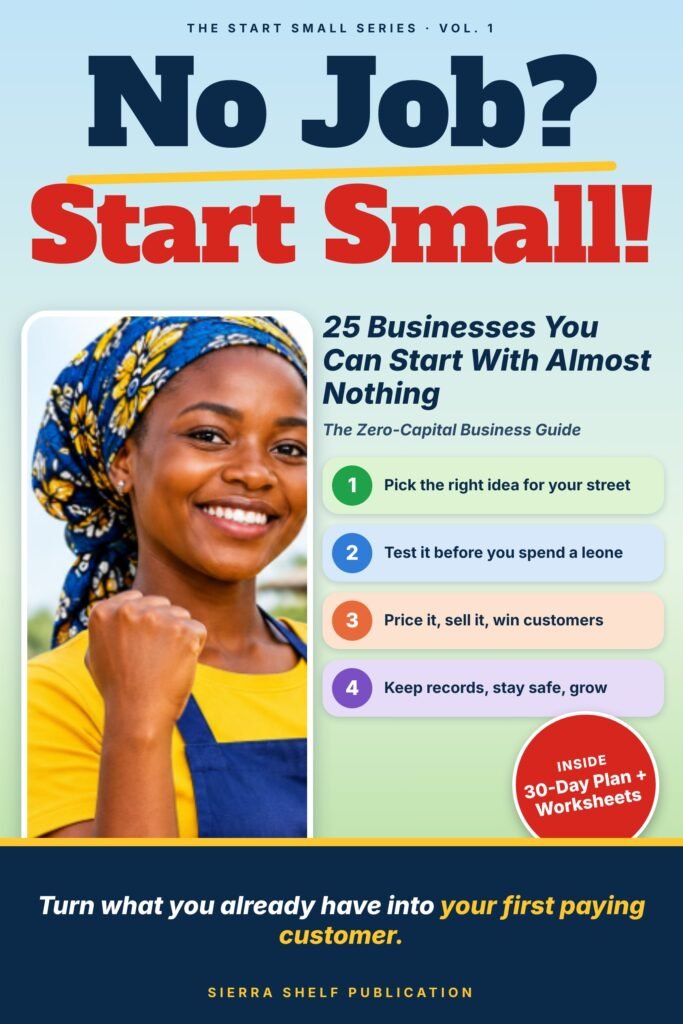
No Job? Start Small!
Brief summary
No job? No money? No problem. This simple, honest guide shows you how to pick a small business, test it with real customers and start earning, using what you already have. Real evidence from Sierra Leone and West Africa, a little humour, and one small action at the end of every chapter.
A map for the person who is tired of waiting
Waiting for the perfect job is like waiting for a bus on a road with no bus stop. You can wait a very long time, and your feet will still be tired.
No Job? Start Small! is a friendly, practical guide for people who have no job, no savings and no big plan, and who are ready to begin anyway. It is written in simple English, with a little humour, and with real evidence from Sierra Leone, Nigeria, Ghana, Liberia and the wider region. No jargon. No empty motivation. Just clear steps you can start this week, with the money you already have, which for many readers is zero.
Each chapter ends with a 30-minute action and a worksheet, so you do not only read. You begin.
What you will be able to do
- Choose a small business you can start with little or no money.
- Test your idea with real customers before you spend a single leone.
- Set prices that leave you a real profit, not just a busy day.
- Keep simple records so you always know if you are winning.
- Avoid the crowded-market trap and the common money mistakes that close small businesses.
- Grow step by step, without borrowing trouble.
Who this book is for
School leavers and graduates who are tired of sending out letters. Traders and workers who want a second income. Parents, young women and men who want to earn at home. Anyone with a notebook and 30 minutes. If that is you, this book was written for you, and it will not talk down to you.
Vol. 1 of The Start Small Series. Soft copy (PDF), 14 chapters. Delivered to you after payment.
Chapter 1: You Are Not Behind
Twenty dollars and a very bad week
After the 2017 mudslide in Freetown, a young man named Alhaji Siraj Bah had almost nothing. He was a teenager. He had grown up far from the capital. He slept on the street or with friends.
He did not sit and wait for a job. He had about $20 saved. With it, he began making bags from recycled materials, including banana leaves, and printing business logos on them for local companies. In the days that followed, a hotel manager placed an order for a thousand bags.
His story was told in the press, and some details come from Bah himself. So read it as his own account, not as an audit report. But one part needs no audit. He started with an amount most of us can find. And he started before he felt ready.
Nobody ever feels ready. People who say they felt ready are usually lying, or selling a course.
That is the message of this book. You do not need to be rich. You do not need powerful friends. You do not need a perfect plan. You need a small first step, taken soon. Then another one.
Truth one: you are not the problem
If you have no job, you may feel that everyone found a chair when the music stopped, and you were left standing. The numbers tell a different story.
Sierra Leone's official unemployment rate is low. The World Bank estimates it at about 3% in 2025. That sounds like good news. But look at what "unemployed" means. Under the official rules, you are unemployed only if you did no work at all, you were ready to work, and you were looking for work. In a country where most families need daily income to eat, almost nobody can do no work at all. People sell, carry, cook, fix and help. So they count as "employed", even when the pay is small and uncertain.
So the statistic says you are employed. Your wallet may disagree.
This means the real problem is not "no work". It is poor-quality work. The work is not steady, the pay is low, and there is no protection if you fall sick. In this book, we call this kind of work informal: no written contract and no safety net. The table shows how common it is.
| What was counted | Number | Source |
|---|---|---|
| Young workers (ages 15 to 29) in informal jobs, 2015 | 89.4% | ILO school-to-work survey |
| Young people without enough work (no work, or too few hours), 2015 | 66.2% | ILO school-to-work survey |
| Workers who work for themselves, 2025 (the world average in 2023 was 40%) | 88.8% | World Bank modelled data |
| Workers in the informal sector, 2021 report | 86% | UNCDF, cited by the Ministry of Finance |
| Workers in the whole world with informal jobs, 2026 estimate | 57.7% (2.1 billion people) | ILO, reported by Manila Bulletin |
Look at the last row. It is about the whole world. More than half of all workers on earth have informal jobs. So you are in the big crowd, not alone at the back. In Africa the share is even higher. One report estimated that nearly 90% of young working Africans are in the informal economy.
One small warning. Sierra Leone's most detailed job surveys are several years old. Different sources also give different numbers for youth unemployment, because they count in different ways. This book uses named surveys and tells you the year. When a newer survey comes out, trust it over the older one.
Truth two: starting is easy, lasting is hard
Africa already has many people who start businesses. The Global Entrepreneurship Monitor (GEM) is the largest world study of new businesses. It has found that sub-Saharan Africa has by far the most people in early-stage business activity. Its women's report found that 25.9% of adult women in the region were starting or running a new business, the highest in the world. About 62% of them said they did it to use an opportunity, not because they had no choice.
But the same report brings a warning. The region also had the highest rate of businesses closing. About 56% of women who closed said the business made no profit, or they had no money. Another GEM report said that much business activity in the region is in crowded areas such as retail.
Put these three facts together. Starting is common. Surviving is harder. And when everyone sells the same thing, profits get thin. If ten people sell phone chargers on one street, the only winner is the customer.
That is why this book spends more time on choosing, testing, pricing and record-keeping than on motivation. Motivation is nice. But motivation cannot balance your cash book.
Some African researchers also warn about hype. A 2026 paper from LEAP Africa, The Founder Fallacy, says that starting a business has become the usual answer to youth unemployment. It says this creates many founders but few lasting businesses. We take this seriously. This book will not tell you that everyone must become an entrepreneur. It will not promise a quick rescue. It will help you test a small idea cheaply, so you can find out for yourself.
Truth three: a good habit can be taught
Many people think entrepreneurs are born with a special spirit. Research from West Africa says the spirit can be taught.
In Togo, economists tested this with 1,500 owners of small businesses. One group took a well-known business course, with topics like accounting and marketing. A second group took "personal initiative" training. This teaches a go-getter way of thinking: see opportunities, act without waiting to be told, and keep going when things are hard. A third group got nothing. After two years, the personal initiative group had 30% more profit. The business course group had 11% more, but that gain was too small to rule out luck.
Seven years later, the researchers checked again. They found lasting gains of about $91 more profit per month. The pattern was different for men and for women. There are two lessons here. First, training the mindset worked better than classroom theory. Second, the gains were modest and uneven, not magic. So build the habit of taking initiative, and do not wait until you feel confident.
Personal initiative has three parts you can practise from today:
-
Start yourself: do something useful without waiting to be told.
-
Look ahead: think about what customers will need next week, not only today.
-
Do not quit at the first "no": when something fails, try another way.
The third part includes the customer who says, "I will come back tomorrow." That customer will not come back tomorrow. Find another customer.
Across West Africa and Beyond
Sierra Leone is not an exception. Informal jobs made up 86.3% of all jobs in sub-Saharan Africa in 2024, the highest share of any region. The ILO puts informality at around 90% in West, Central and East Africa. World Bank data on self-employment tell the same story. In 2023, about 85% of workers in Nigeria and about 79% in Liberia worked for themselves, against a world average of about 40%.
In Liberia, about 87% of workers are in smallholder farming or unregistered micro-enterprises, and 14.8% of 15 to 24-year-olds are in no school, job or training. The World Bank's Africa's Pulse report says the region has the highest rates of self-employment and unpaid family work in the world, and that much of it is involuntary. In plain words: for millions of people from Freetown to Lagos, "start something" is not a fashion. It is the road that exists.
So this book speaks to a trader in Accra, a tailor in Kano and a bike rider in Monrovia as much as to a reader in Freetown. Prices, rules and currencies differ, so each chapter has a short box like this one. Use the principles everywhere, and check the local numbers where you live.
Start Small in 30 Minutes
Do these four things today. You need a pen and a notebook.
-
Write today's date and this sentence: "I am starting from here."
-
Fill in the worksheet below. Be honest. Nobody else will read it.
-
Take one useful action that nobody asked you to take. For example, ask a neighbour what they wish they could buy nearby. Do it before tomorrow.
-
Tell one person you trust that you will start something small this month.
Mistake to avoid: waiting
The most common mistake is waiting. People wait for a job, for money, or for the perfect idea. Alhaji Siraj Bah's story is not special because of his $20. It is special because he moved before things were perfect. Waiting also costs something. Every month of waiting is a month with no income, no experience and no customers.
The second mistake is copying the crowded business. For example, you open one more small stall right next to another one, and you sell the same things. Chapter 4 shows you how to choose better.
Worksheet: Where I Am Today
| Question | My answer |
|---|---|
| How did I earn money or goods in the last 30 days? | |
| How many hours a week could I use for a new activity? | |
| How much money could I spend on a start without hurting my family? (It may be zero.) | |
| What is one thing people around me complain about or wish they could get? | |
| One small action I will take in the next 24 hours: |
You have read Chapter One. Now keep going.
If you finished that chapter and your hand is itching for a pen, that itch is the whole point. Chapters 2 to 14 show you exactly how to turn that itch into a first customer and then a steady income.
A small business can start this month. The only thing it cannot survive is another year of waiting. Get your copy today, and take your first small step before the week ends.
Purchase this Book
You have finished Chapter One of No Job? Start Small!. To read the rest, buy the book for NLe 120:
- Pay the book price using the displayed Orange Money Number:
+232 72 008 615 - Send evidence of payment (the payment receipt) to this WhatsApp Number:
+23273687248 - The soft copy of the book will be sent to you.